Voicemail escalation
VMAlerts turns a voicemail into a phone call to a real person — and keeps calling your on-call rotation until somebody takes responsibility.
$50 per month, per number · $100 one-time setup · any number of people in the rotation
The problem
The phone rings out. The caller leaves a message describing something that matters to them — a leak, an outage, a patient, a stranded lorry. That message then sits in a mailbox, silent, until somebody happens to check it.
Delivers the message to an inbox nobody is watching at 2am. It is a record, not an alert.
Works until that person is asleep, driving or off shift. There is no second name, and no way to know it was missed.
Relies on somebody remembering to look. Nothing records who was asked or what they said.
Charges per call, adds a stranger between caller and engineer, and still ends in a call to your own on-call list.
“Did anyone deal with the message that came in on Saturday night?” Without a record of who was called, when, and what each person said, the honest answer is usually “probably”.
What VMAlerts does
Two things happen the moment a voicemail arrives, and they happen at once.
An email goes out immediately with the recording attached and a written transcript in the body — so whoever opens it can read the message without listening to it.
Your on-call list is worked through in the order you set, one person at a time, until somebody accepts. Nobody's phone competes with a colleague's.
Answering the phone is not accepting. Somebody has to hear the message and press 1. That distinction is what makes the record meaningful — VMAlerts records the difference between a phone that was answered, a machine that picked up, and a person who listened and declined.
The console
The dashboard answers both questions in one screen.
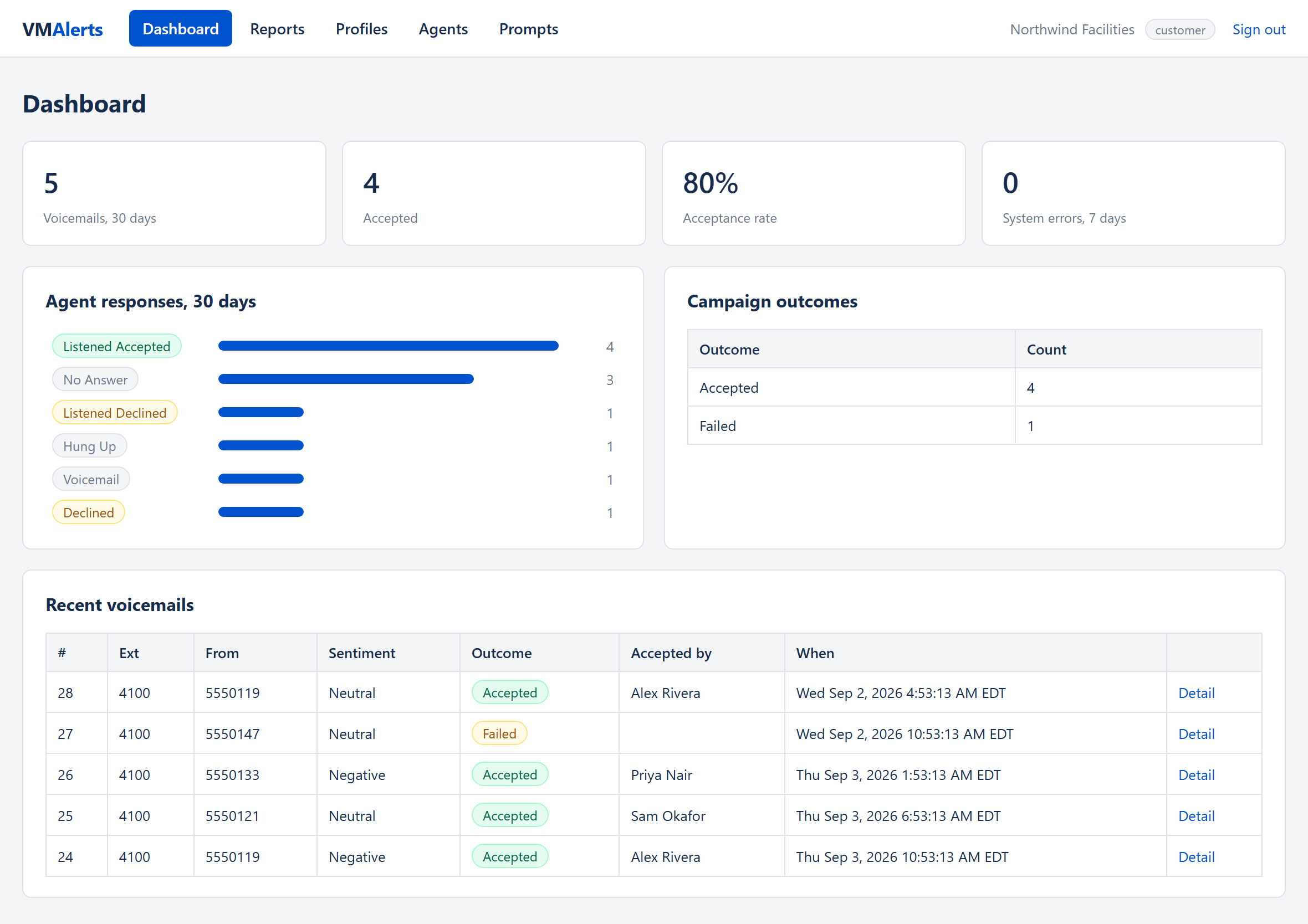
It is the percentage of messages somebody took responsibility for. A falling rate tells you the rotation is not working long before a customer complains about it.
The record
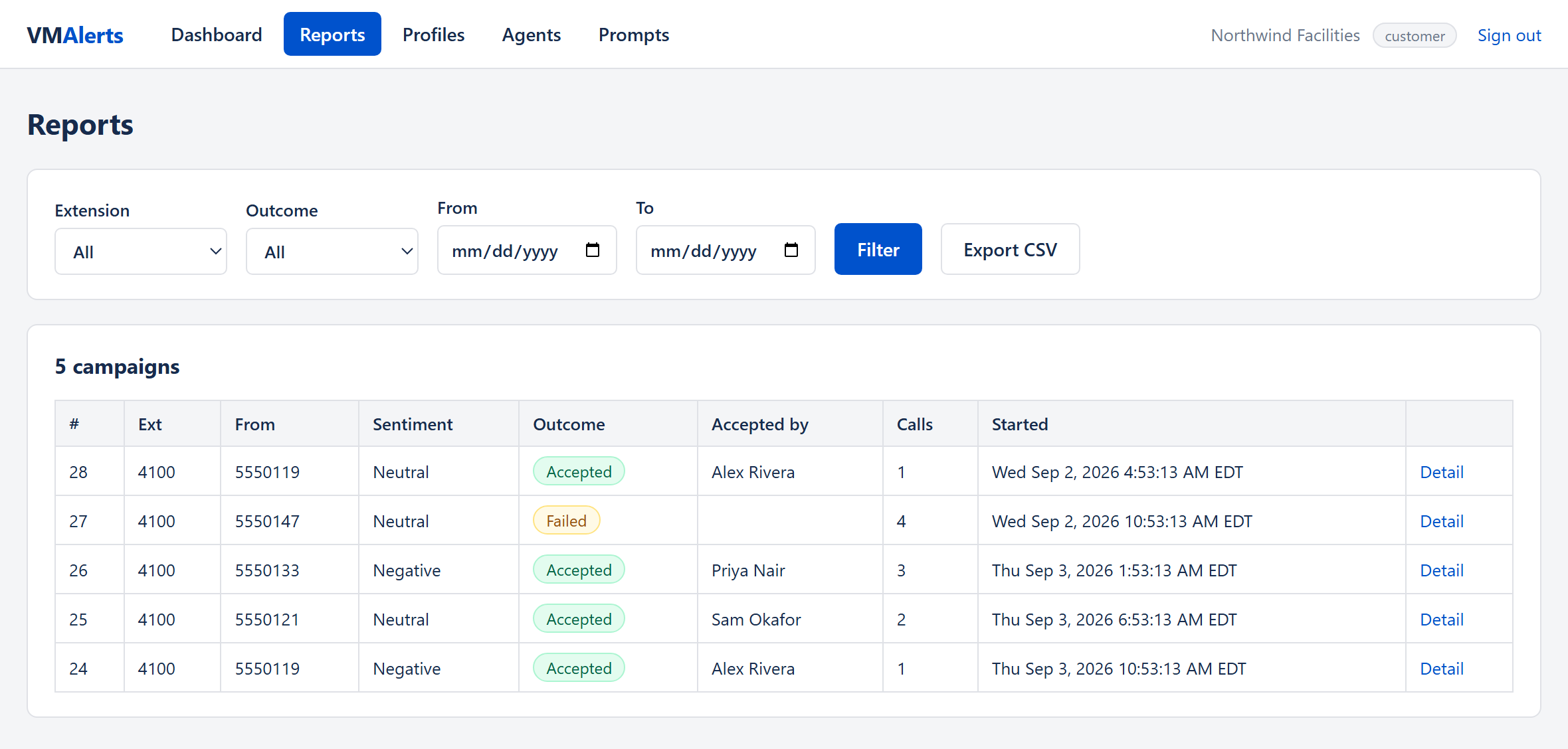
Every voicemail and every attempt, searchable and exportable. Narrow by number, outcome or date range, then open any row for the full account of what happened. Export CSV gives you exactly the rows you are looking at, not everything.
Useful long after the night in question. When a customer asks why nobody called back, or a contract requires evidence that somebody responded, the answer is a filter away — with the recording, the transcript and the timings still attached.
Yours alone
Your account is tied to your numbers. You see your voicemails, your roster and your settings — and nothing belonging to anybody else.
Calls to your on-call people show your own number, not somebody else's. They recognise the caller and answer it.
Maintain your rotation, recipients and announcements yourself, whenever the roster changes. No ticket, no waiting.
An account with nothing granted sees nothing at all, rather than everything. Any attempt to reach another organisation's data is refused and written to the log.
Accounts can be deactivated when somebody leaves without deleting anything they did, and every sign-in is recorded.
The call record is append-only: results are added, never edited. An audit log records every sign-in, change and refused access.
What it costs
Everyone who answers for that number is included. Adding a second name to the rotation costs nothing.
Charging by the number rather than the person means the cost is predictable. A bad week with forty callouts costs the same as a quiet one — which is exactly when a per-call service becomes expensive.
Getting started
An existing setup can be brought across as it stands — the rotation, the order, the recipients and the number each group of staff sees when their phone rings. Nothing has to be retyped, and nothing goes live until you have checked it.
 VMAlerts